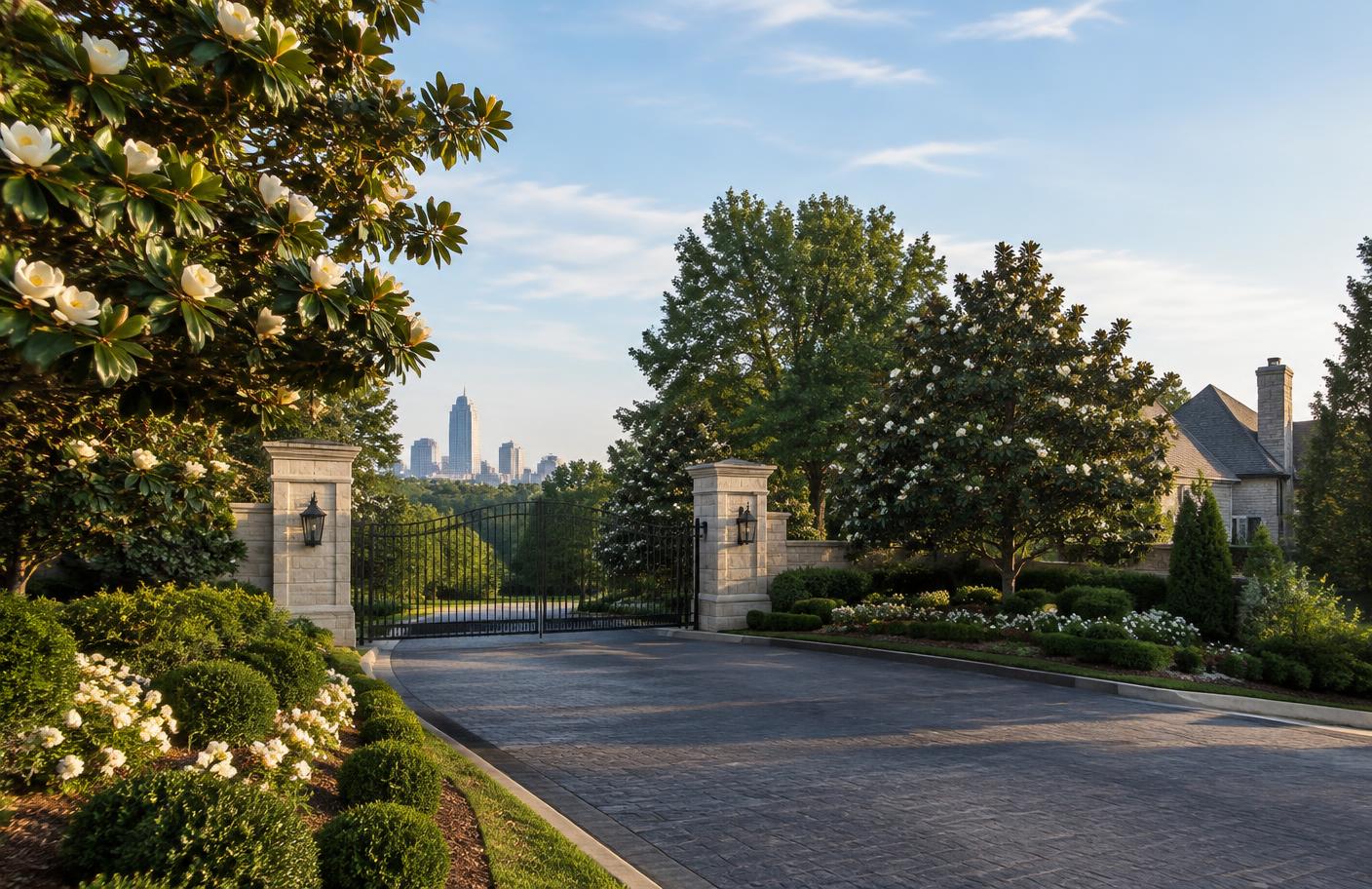
One gate, one community
Privacy in a city neighborhood is rarely accidental. Morrocroft Estates was platted with a single controlled entrance rather than a permeable street grid, which means through-traffic has no reason to enter and every arrival is a deliberate one. The staffed gate is the most visible expression of that plan, but the street layout behind it does just as much work.
Interior streets curve rather than run straight, sight lines are short, and homes are set back behind planted verges. A visitor sees very little of the community from any one point, an unusual quality inside a district as busy as SouthPark in Charlotte, North Carolina. The plan rewards residents with quiet and gives guests a clear sense of arrival.
Estate-scale lots inside a busy district
The land plan favors generous lots with deep setbacks, which is what allows estate-scale houses of roughly ninety custom homes to sit comfortably without crowding one another. That scale is the practical reason Morrocroft Estates reads as secluded even though SouthPark Mall, Symphony Park, and the district's restaurants are only minutes away.
Few Charlotte addresses hold both qualities at once. Most genuinely private enclaves trade proximity for acreage farther south toward the state line, where lots grow but daily errands lengthen. Morrocroft keeps the acreage and the proximity together, which is the core of its appeal and the reason the community is so often the first gated address buyers in SouthPark examine.
The land behind the name
The community takes its name from Morrocroft, the country estate and model dairy farm of Governor Cameron Morrison, whose manor house was designed by architect Harrie T. Lindeberg around 1930. Much of the former estate acreage later became the SouthPark district, and Morrocroft Estates was developed on part of that land beginning in the 1990s.
That provenance matters to privacy in a practical way. The surrounding parcels developed as a planned district rather than as piecemeal infill, so the edges of the community are bordered by established uses and mature trees rather than by unpredictable new construction. The history page on this site traces that transition from farm to gated enclave in detail.
Why the character has held
Covenants, an active homeowners association, and a build-out concentrated in the 1990s and 2000s have kept the streetscape coherent. Homes have been renovated extensively over the last decade, but the canopy, the setbacks, and the material palette have stayed consistent, which is why the community still photographs as one place rather than a collection of eras.
Architectural review is the quiet mechanism behind that consistency. Exterior changes generally move through the association's review process before work begins, which keeps rooflines, materials, and landscape screening in conversation with the neighbors. Current rules, dues, and approval timelines change over time and should be confirmed directly with the association before any purchase or renovation decision.
Privacy as a daily experience
For residents, privacy shows up less as a feature than as an absence: no cut-through traffic, no rideshare loops, no unannounced foot traffic past the front door. Deliveries and guests are handled at the gate, and the interior streets stay calm at hours when the rest of SouthPark is at its busiest.
Inside the home, the same priority shapes design choices. Owners commonly invest in landscape screening, discreet lighting, and integrated security and audio-video systems that work quietly in the background. The smart homes and interior design guides on this site cover how those systems are typically planned in estate-scale houses.
How it compares with Charlotte's other enclaves
Historic neighborhoods such as Myers Park and Eastover offer extraordinary architecture and canopy, but they are open-street communities by design. Quail Hollow pairs privacy with a golf-club setting, and Foxcroft offers larger wooded lots with a different street character. Morrocroft Estates is distinct for combining a staffed gate, uniform estate scale, and a central SouthPark position.
None of these is objectively better; each answers a different set of priorities. The comparison guides on this site set the communities side by side on access, architecture, lot character, and location so readers can weigh those trade-offs for themselves. All figures cited across this guide are estimates and should be independently verified.
This journal is published by an independent editorial guide. It is not the Morrocroft Estates Homeowners Association, a developer, a brokerage, or a school, and nothing here is legal, financial, appraisal, or brokerage advice. Figures are estimates and should be independently verified.